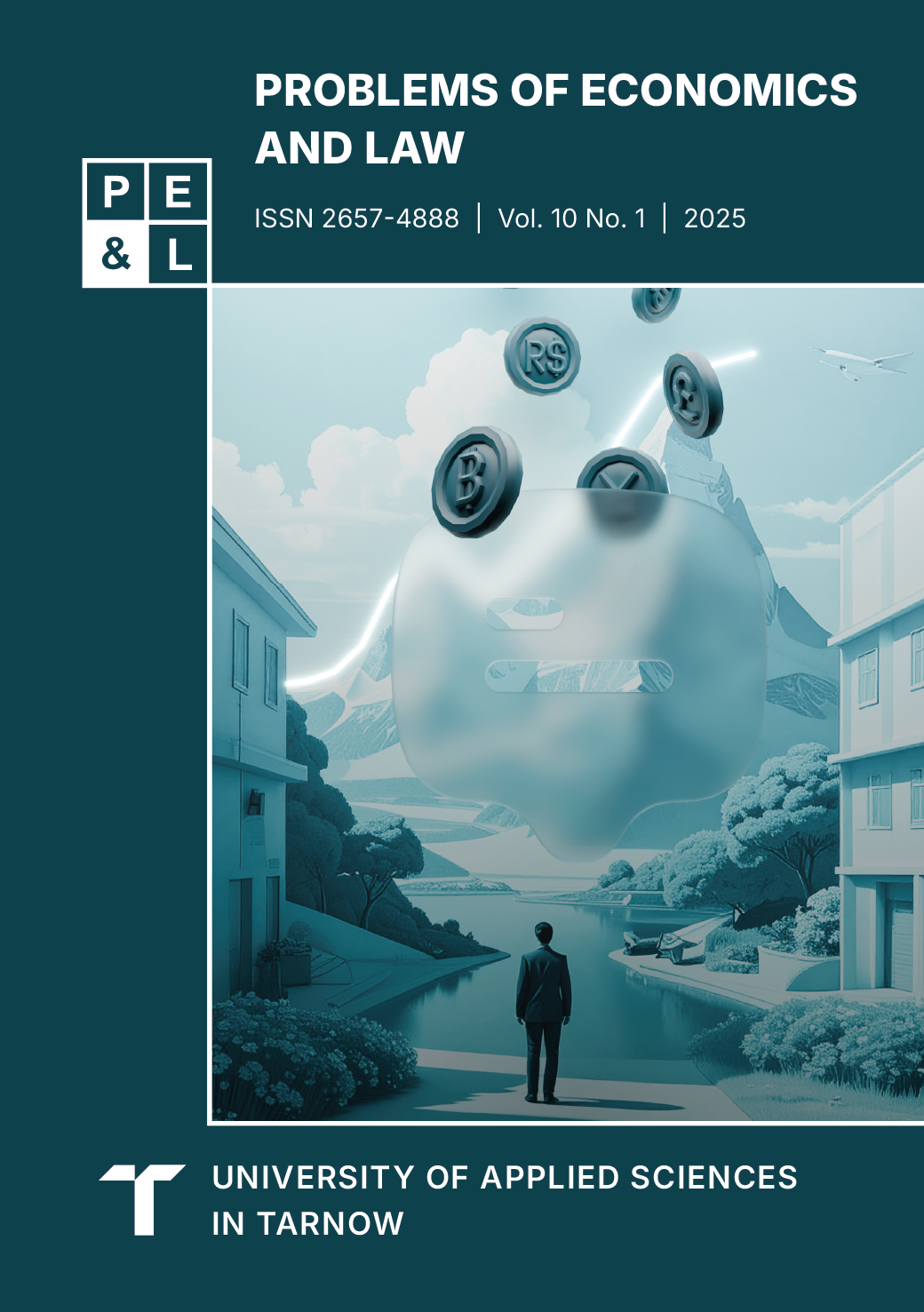
The impact of local exchange rate fluctuations and commodity prices on the trade balance of ECOWAS countries
DOI:
https://doi.org/10.55225/pel.634Keywords:
ECOWAS, currency depreciation, commodity prices, tradeAbstract
The article is an attempt to identify the impact of depreciation of the local currency and growth of the prices of selected commodities on the trade balance inside the Economic Community of West African States (ECOWAS). For this purpose, multiple regression method with lags was used, which included quantitative and dummy variables. Both the general model and the isolated models were constructed for the selected countries belonging currently or in the past to the ECOWAS. For the two-stage selection of variables, graph analysis was used, whereas the models were checked in terms of meeting the assumptions of linear regression. The results showed that the changes of commodity prices influence the trade balance to a higher degree than the fluctuations of commodity prices, although both of these relationships have a form of negative correlation. The negative influence of these factors on the balance of trade is related to higher import costs, deepened by the unfavourable commodity structure of trade in the ECOWAS countries. Furthermore, there appear to be no significant differences in this matter between current and former organisation members. This indicates a limited significance of the economic factors in creation of The Alliance of Sahel States, the alternative regional organisation to ECOWAS.
Downloads
References
Ackah, Ch., Turkson, F. E., Opoku, K. (2013). Measuring Trade Costs in Economic Community of West African States (ECOWAS). Modern Economy, 4(1), 63. DOI: 10.4236/me.2013.41007.
Ambukita, E. (2018). Wspólnota Gospodarcza Państw Afryki Zachodniej jako przykład integracji gospodarczej w Afryce. Studia i Prace WNEiZ US, 53(2), 20. DOI: 10.18276/sip.2018.53/2-01.
Ampuła, D. (2015). Wartości resztowe w procesie regresji. Problemy Techniki Uzbrojenia, 44, 86–87.
Avoulete, K. (2022). Should ECOWAS rethink its approach to coups. Foreign Policy Research Institute, 3, 2.
Bank Światowy, Commodity markets (2025). Dostępny w Internecie: https://www.worldbank.org/en/research/commodity-markets [dostęp: 2025-02-22].
Bijak-Kaszuba, M. (1998). Preferencyjne porozumienia handlowe a liberalizacja obrotów międzynarodowych. Acta Universitatis Lodziensis. Folia Oeconomica, 146, 18.
Bitner, A. (2007). Konstrukcja modelu regresji wielorakiej przy wycenie nieruchomości. Acta Scientiarum Polonorum Administratio Locorum, 6(4), 65.
Chlebisz, A, Mierzejewski, M. (2020). Determinants of GDP growth in Scandinavian countries with special reference to scientific progress. International Entrepreneurship Review, 6(3), 28. DOI: 10.15678/IER.2020.0603.02.
Dudek, H. (2005). Wykrywanie współliniowości za pomocą scentrowanych, niescentrowanych oraz uogólnionych czynników inflacji wariancji (Detecting of Collinearity by Using Centered, Noncentered and Generalized Variance Inflation Factors). Prace Naukowe Akademii Ekonomicznej we Wrocławiu. Taksonomia, 12(1076), 8.
Firlej, K. (2017). Przemysł spożywczy w Polsce: nowa ścieżka rozwoju. Warszawa: Wydawnictwo Naukowe PWN.
Firlej, K. A. (2016). Programowanie rozwoju innowacyjności jako instrument podnoszenia konkurencyjności regionów w Polsce na tle Unii Europejskiej. Kraków: Fundacja Uniwersytetu Ekonomicznego w Krakowie.
Foryś, I., Batóg, B. (2015). Modelowanie aktywności nabywców mieszkań na rynku województwa zachodniopomorskiego. Zeszyty Naukowe Uniwersytetu Ekonomicznego w Krakowie, 5(941), 41. DOI: 10.15678/ZNUEK.2015.0941.0503.
Garlińska-Bielawska, J. (2022). Informal Cross-Border Trade in African Economic Communities – The Case of the ECOWAS and the WAEMU. Studia Sieci Uniwersytetów Pogranicza, 6, 63. DOI: 10.15290/sup.2022.06.05.
Gurtner, F. J. (1999). The CFA Franc zones and the theory of optimum currency area. Africa Spectrum, 34.
Iyoha, M., Okim, A. (2017). The impact of trade on economic growth in ECOWAS countries: Evidence from panel data. CBN Journal of Applied Statistics, 8(1), 45–46.
Kohnert, D. (2024). Navigating rivalries: prospects for coexistence between ECOWAS and AES in West Africa. Hamburg Institute of African Affairs. DOI: 10.2139/ssrn.4902691.
Kuś, A., Pawlik, M. (2016). Wykorzystanie modelu regresji wielorakiej do określenia czynników z obszaru płynności finansowej kształtujących efektywność w przedsiębiorstwach przemysłowych. Finanse, Rynki Finansowe, Ubezpieczenia, 82, 101. DOI: 10.18276/frfu.2016.4.82/1-08.
Mati, S., Civcir, I., Ozdeser, H. (2023). ECOWAS common currency, a mirage or possibility? Panoeconomicus, 70(2), 256. DOI: 10.2298/PAN191119015M.
Mielcarek, J. (2014). Ekonometryczny model deficytu sektora instytucji rządowych i samorządowych. Zeszyty Naukowe Uniwersytetu Ekonomicznego w Krakowie, 932(08), 59. DOI: 10.15678/ZNUEK.2014.0932.0804.
Mišević, P. (2022). International Trade of ECOWAS Member Countries. InterEULawEast: Journal for the International and European Law, Economics and Market Integrations, 9(1), 118. DOI: 10.22598/iele.2022.9.1.5.
Mitręga-Niestrój, K. (2017). Funkcjonowanie Strefy Franka CFA – wstęp do krytycznej analizy. Annales Universitatis Mariae Curie-Skłodowska, Sectio H: Oeconomia, 51(4), 254. DOI: 10.17951/h.2017.51.4.247.
Mohapi, M. (2021). The CFA franc zone: A modern reincarnation of a colonial relic. The University of Cape Town.
Mróz, M. (2017). Dobór zmiennych niezależnych w modelowaniu procesów logistycznych metodą analizy grafów. Zeszyty Naukowe Akademii Sztuki Wojennej, 142.
Nenovsky, N., Bondi, G. (2024). A proposal for a common currency based on resources of the Alliance of Sahel States. Theoretical and practical issues. BRICS Journal of Economics, 5(3), 107. DOI: 10.3897/brics-econ.5.e133581.
Ntongho, R. A. (2024). Why Institutions Matter for Eco Currency. The African Review 1(aop), 566. DOI: 10.1163/1821889x-bja10119.
Nzally, J. H. (2022). Understanding the Fall of Yahya Jammeh in the December 2016 Presidential Elections.
Obserwatorium Złożoności Ekonomicznej, Historical country data (2025). Dostępny w Internecie: https://oec.world/en [dostęp: 2025-02-22].
Oluyemi, O. A. (2025). The Cold War Resurgence: A Discourse on the Rivalry between ECOWAS and AES in West Africa. International Journal of Social Sciences and English Literature, 9(1), 5. DOI: 10.55220/2576683x.v9.244.
Pawlak, K., Kita, K. (2014). Skutki potencjalnej liberalizacji światowego handlu rolnego dla sektora rolno-żywnościowego Wspólnoty Gospodarczej Państw Afryki Zachodniej (ECOWAS). Journal of Agribusiness and Rural Development, 32(2), 112.
Pitigala, N., López-Cálix, J. (2021). Designing Trade Policy Options for Export Diversification: The Cases of Mali, Chad, Niger and Guinea. LAP LAMBERT Academic Publishing.
Popławski, B., Szeniawska, K. (2013). Społeczne aspekty uprawy kakao w Wybrzeżu Kości Słoniowej w kontekście zasad międzynarodowego handlu i konsumpcji. Polska Akcja Humanitarna.
Shuaibu, M. (2015). Trade liberalization and intra‐regional trade: A case of selected ECOWAS countries. African Development Review, 27(1), 37. DOI: 10.1111/1467-8268.12120.
Surazu, M. M., Stefanović-Štambuk, J. (2023). The Cause of Diplomatic Failure in the Sahel Region and the Rising Coups. International Journal of Research and Innovation in Social Science, 7(12), 1006. DOI: 10.47772/IJRISS.2023.7012076.
Świercz, W., Szostak R. (2024). Modelowanie Ekonometryczne Kapitału Inwestorów Indywidualnych Na Rynku Głównym GPW. W: Stanimir, A. (red.). Współczesne problemy społeczno-ekonomiczne w ujęciu analitycznym (s. 155). Wroclaw University of Economics and Business.
Taboga, M. (2021). "Dummy variable", Lectures on probability theory and mathematical statistics. Kindle Direct Publishing Online appendix. Dostępny w Internecie: https://www.statlect.com/fundamentals-of-statistics/dummy-variable [dostęp: 2025-02-22].
Trading Economics, Trade and markets indicators (2025). Dostępny w Internecie: https://tradingeconomics.com/ [dostęp: 2025-02-22].
Wójcik, A. (2014). Modele wektorowo-autoregresyjne jako odpowiedź na krytykę strukturalnych wielorównaniowych modeli ekonometrycznych. Studia Ekonomiczne, 193, 120.
Downloads
Published
Issue
Section
License
Copyright (c) 2025 Arkadiusz Chaim

This work is licensed under a Creative Commons Attribution-ShareAlike 4.0 International License.